

From 31 October your councillor can no longer call a planning application in to committee in North Somerset. Councillors vote on the new rules on Wednesday.
If a neighbour’s development worries you, the standard advice in North Somerset has been to ask your ward councillor to call it in so that elected members decide it in public. From 31 October that route closes, and nothing replaces it as a right.
North Somerset Council’s Planning and Regulatory Committee is asked on Wednesday 23 September to adopt new procedures that take effect on that date. The officer report is blunt about the reason: “This means the Council’s existing procedure of Ward Member call-in powers can no longer be applied” (New Scheme of Delegation report, page 2).
The change is national, not a local choice. The Town and Country Planning (Discharge of Local Planning Authority Functions) (England) Regulations 2026 were made on 15 July and come into force on 31 October (SI 2026/854). Every council in England has to rewrite its rules to match. What each council does with the discretion it is left is local, and that is what Wednesday’s vote settles.
What changes on 31 October
The regulations sort applications into two groups.
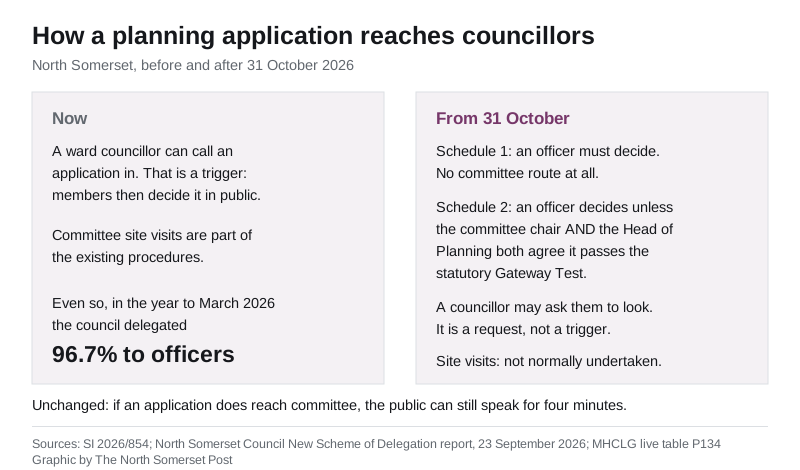
- Schedule 1 must be decided by an officer. There is no discretion at all. That covers householder applications, minor commercial work, minor residential schemes of one to nine homes on under half a hectare, permission in principle, lawful development certificates, non-material amendments and prior approvals.
- Schedule 2 goes to an officer by default. Major applications, listed building consent, advert consent and tree preservation order applications can reach a committee, but only if two named people agree it should.
Those two people are the nominated member and the nominated officer. The draft procedures name them as the chairperson of the Planning and Regulatory Committee and the Head of Planning, with the vice-chairperson and the Planning Policy Manager standing in if either is absent. The report says the council’s constitution was updated on 14 July 2026 to confirm those roles. Both have to agree, applying a statutory “Gateway Test”, that the application raises either an issue of economic, social or environmental significance to the local area, or a significant planning matter under the development plan. If they cannot agree, an officer decides it.
A ward councillor can still ask them to look at an application. The new code of practice sets out how: a written request on a prescribed form, sent to the case officer and to a council mailbox, giving reasons. But it is a request, not a trigger, and the report is clear that “the regulations do not allow for call-in or referral of these applications to committee outside this process”.
How little was going to committee anyway
The council already delegates almost everything. In the year to March 2026 North Somerset made 1,139 planning decisions and 96.7% of them were delegated to officers, slightly above the England figure of 96.4% (MHCLG live table P134). That leaves roughly one decision in thirty for councillors.
The committee’s own 2026 agendas show what that looks like in practice. Across seven meetings from January to September it has had twelve planning application items. Two further meetings, on 20 May and 19 August, were cancelled, both recorded on the council’s site as called off “due to lack of business”.
The last one is a good illustration of what the new rules would have stopped. On 15 July the committee heard application 26/P/1010/PIP, permission in principle for land at the former Flax Bourton railway station on Clevedon Road. A local resident spoke against it, the applicant’s agent spoke for it, the ward member for Long Ashton addressed the committee, members debated access for emergency services and the site’s planning enforcement history, and then voted to grant it (minutes, 15 July 2026).
Permission in principle is item 6 of Schedule 1. After 31 October that application could not have gone to the committee at all, whoever asked.
Two things the council has chosen for itself
The regulations leave some room, and North Somerset’s draft uses it in two ways worth noting.
The first is transparency, and it is the better half. Every Gateway Test decision “must be recorded, together with the reasons for the decision, reported to the Planning and Regulatory Committee, and made available for public inspection on the Council’s website”. That is a commitment some councils have not made. The draft does not say how often those decisions will be published, or whether the nominated persons will meet in public.
The second is site visits, and it is a real reduction. The draft states that “Committee site visits will not normally be undertaken”, and will happen only where the chairperson and a senior planning officer both agree one is necessary. It goes further: a visit “is intended as a private session for members of the Committee only”, and “Members are discouraged from sharing details of site visits with outside parties”.
There is also a timing problem residents cannot work around. A councillor’s referral request must arrive “before the Director’s authorised representative has countersigned the case officer’s written recommendation”. That moment is not published anywhere, so there is no date a resident can look up and work back from.
What stays the same
Two things are unchanged, and it is worth being precise about them.
- Public speaking rights are untouched. If an application does reach the committee, you can still ask to speak, for four minutes, with the same deadlines as now. What you lose is a reliable route to a hearing, not the microphone.
- The committee is not being resized. The regulations cap a committee that determines applications at 13 members. North Somerset’s has 12, so it already complies.
Unusually, this is also the end of the process rather than the start of it. At some councils the committee recommends and Full Council adopts. Here the constitution was already changed in July, and the committee itself is asked to adopt the procedures on Wednesday.
What it means for you
- Object in writing, early, and to the case officer. Comments on the application are now almost always the only thing an officer weighs, because the officer is almost always the decision maker. Our North Somerset planning news page explains how to find and comment on a live application.
- Ask your councillor sooner, not later. A referral request has to be in before the recommendation is signed off, and you will not be told when that is. Raising it in the first days of the consultation period is the only safe approach.
- Argue the statutory test, not the local upset. A request now has to say why the application raises an issue of economic, social or environmental significance, or a significant planning matter under the development plan. Strength of feeling on its own no longer has anywhere to go.
- Watch for the published gateway decisions. If the council keeps its promise to publish every one with its reasons, that list is the record of what was, and was not, thought significant enough for councillors.
The meeting is at 2.30pm on Wednesday 23 September in the New Council Chamber at Weston-super-Mare Town Hall. The agenda states that it will not be livestreamed, so attending in person is the only way to watch it. Requests to speak must reach the council by noon on the day before (agenda, 23 September 2026).
Have your say