
76% of North Somerset homes are in council tax bands A to D and qualify for the £100 Household Energy Payment from January. See how it varies, Weston to Portishead.
About three in four homes in North Somerset fall into the council tax bands that qualify for the new £100 Household Energy Payment. The money will be paid from January 2027.
The Chancellor announced the payment in the Budget on Wednesday 28 October. It goes to households in council tax bands A to D in England, to help with energy bills (GOV.UK, 28 October).
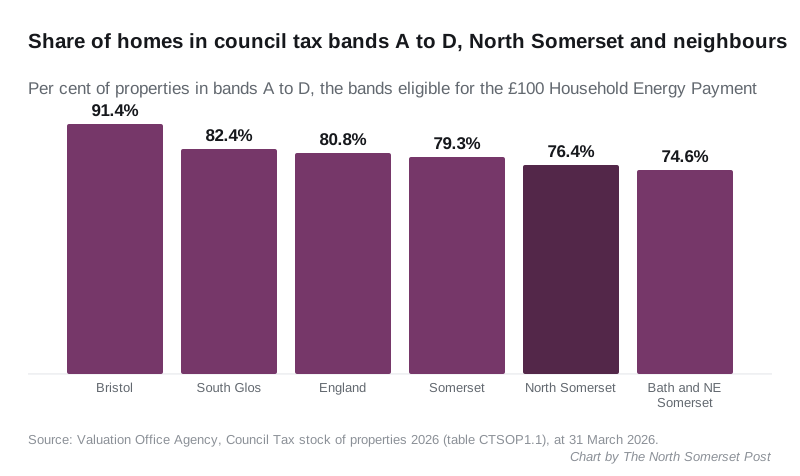
North Somerset had 78,560 properties in bands A to D out of 102,800 at 31 March 2026. That is 76.4%, according to the Valuation Office Agency. The England figure is 80.8%.
The count is of properties, not households. Second homes and empty homes are on the list but will not get the payment, so the number of North Somerset households paid will be lower.
How it works
The government’s rules so far (GOV.UK):
- Who gets it: the person liable for council tax on a band A to D home that is their main home. Most households exempt from council tax are included too.
- Who does not: second homes, empty properties, and households where the person living there is not the one responsible for the bill.
- If you pay by Direct Debit: you do not need to do anything. The £100 goes into your bank account.
- If you do not pay by Direct Debit: North Somerset Council will invite you to apply.
- If you are in band E or above: councils will share an extra £100 million nationally for discretionary help. Each council sets its own rules.
The government warns that nobody other than your council should contact you about claiming it. If a message asks for bank details, check with the council first.
How North Somerset compares
North Somerset has a lower share of homes in bands A to D than its neighbours to the north. Bristol is at 91.4% and South Gloucestershire at 82.4%. Only Bath and North East Somerset, at 74.6%, is lower among the councils around it.
North Somerset’s bands A to D break down like this:
| Band | Properties |
|---|---|
| A | 13,970 |
| B | 22,300 |
| C | 24,040 |
| D | 18,250 |
| A to D | 78,560 |
| E to H | 24,250 |
The VOA rounds each count to the nearest 10, so the bands add up to 102,810 rather than the published total of 102,800.
From Weston to Portishead: it varies a lot
The district average hides a big split. The VOA publishes the same counts for 26 neighbourhoods (middle layer super output areas), named here using the House of Commons Library’s names.
In central Weston almost every home qualifies. In parts of Portishead and the villages south of Bristol, fewer than half do.
| Neighbourhood | Homes in bands A to D | Share |
|---|---|---|
| Weston Bournville | 3,640 of 3,650 | 99.7% |
| Weston Town | 5,440 of 5,560 | 97.8% |
| Mid Worle | 4,020 of 4,140 | 97.1% |
| Clevedon South & Yeo | 3,460 of 3,590 | 96.4% |
| Weston Winterstoke | 4,020 of 4,440 | 90.5% |
| Clevedon Central | 3,500 of 3,870 | 90.4% |
| North Worle | 3,570 of 3,990 | 89.5% |
| Weston Milton | 3,770 of 4,320 | 87.3% |
| Weston Hillside | 4,440 of 5,240 | 84.7% |
| Weston Clarence | 2,620 of 3,110 | 84.2% |
| South Worle, West Wick & St Georges | 3,590 of 4,280 | 83.9% |
| Nailsea West | 4,010 of 4,870 | 82.3% |
| Portishead Central | 4,030 of 4,980 | 80.9% |
| Weston Uphill | 2,230 of 2,810 | 79.4% |
| Hutton, Locking & Banwell | 4,670 of 6,030 | 77.4% |
| Portishead South | 2,870 of 3,720 | 77.2% |
| Yatton & Cleeve | 3,290 of 4,640 | 70.9% |
| Pill & Easton | 1,900 of 2,850 | 66.7% |
| Congresbury & Kewstoke | 2,090 of 3,290 | 63.5% |
| Nailsea East | 1,520 of 2,770 | 54.9% |
| Clevedon North & Walton | 1,440 of 2,640 | 54.5% |
| Wrington, Felton & Dundry | 1,430 of 2,830 | 50.5% |
| Long Ashton & Gordano | 2,800 of 5,640 | 49.6% |
| Winscombe, Langford & Blagdon | 2,070 of 4,280 | 48.4% |
| Backwell & Flax Bourton | 1,080 of 2,580 | 41.9% |
| Portishead Redcliffe | 1,130 of 2,710 | 41.7% |
Counts are rounded to the nearest 10 by the VOA.
A council tax band reflects what a home was worth in 1991, not what the people in it earn. So the discretionary fund matters more in the affluent half of the district, where more households on modest incomes will fall outside the £100 scheme.
What the council said
North Somerset Council welcomed the payment in its Budget response on 28 October. Council leader Cllr Mike Bell said he welcomed “the measures announced by the Chancellor to help people deal with the ongoing cost of living crisis, particularly the winter energy payment”.
The council has not yet said how it will run its share of the discretionary fund, or when it will contact households that do not pay by Direct Debit.
What it means for you
- Check your band on GOV.UK or our North Somerset council tax bands page.
- Pay by Direct Debit? You should not need to do anything.
- Pay another way? Watch for a letter or email from North Somerset Council in the new year, and do not respond to anyone else claiming to offer the rebate.
- On benefits? You may also qualify for the £150 Warm Home Discount.
- In band E or above and struggling? Ask the council about the discretionary fund once it publishes its rules.
We will update this page when North Somerset Council publishes its arrangements.
Sources
- GOV.UK, What the Autumn Budget 2026 means for your energy bills, 28 October 2026
- Valuation Office Agency, Council Tax: stock of properties, 2026, table CTSOP1.1, at 31 March 2026
- House of Commons Library, MSOA names
- North Somerset Council, The Chancellor’s Autumn Statement: what it means for North Somerset, 28 October 2026
Have your say