
North Somerset's emissions are down 37% since 2005, but transport has fallen just 13% and is now almost half the total. The council says 2030 net zero is off track.
North Somerset is off track to reach net zero by 2030, the council’s own progress report says. Transport is the reason. Emissions from vehicles have fallen by just 13% since 2005, and they now make up almost half of the district’s total.
The report goes to Full Council on Tuesday 10 November for councillors to note (Climate Emergency progress report, 10 November 2026). The council declared a climate emergency in 2019, with an ambition for both the council and the area to be net zero by 2030.
Its risk table rates missing the area target as HIGH, with the highest possible scores for likelihood and impact. It says progress “is off track”, and that the target “is unlikely to be achieved without significant changes to the transport sector in North Somerset”.
The district’s emissions
The latest government figures cover 2024 and were published in June 2026. They put North Somerset’s emissions at 1,074 kilotonnes of carbon dioxide equivalent. That is 638 kilotonnes, or 37%, lower than in 2005.
Most of that fall came from cleaner electricity and better insulated homes. Transport barely moved:
| Sector | 2005 (kt CO2e) | 2024 (kt CO2e) | Fall | Share of 2024 total |
|---|---|---|---|---|
| Transport | 588 | 513 | 13% | 47% |
| Domestic | 496 | 239 | 52% | 22% |
| Industry | 199 | 102 | 49% | 10% |
| Agriculture | 139 | 97 | 30% | 9% |
| Commercial | 188 | 84 | 55% | 8% |
| Waste | 48 | 29 | 40% | 3% |
| Public sector | 53 | 18 | 67% | 2% |
Land use and forestry absorbed slightly more than it emitted, at minus 8.8 kilotonnes.
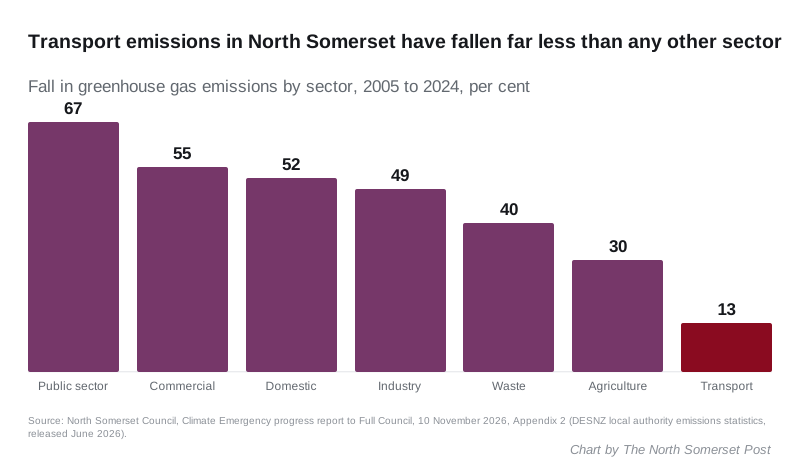
The report says the pattern matches the rest of the country. Transport is the highest-emitting sector in most council areas. It says future progress will depend on people switching how they travel, travelling less, electric vehicles and cleaner freight.
The figures in the table come from the report’s own sector table. Its summary text gives a 22% fall for household emissions, but the table shows household emissions falling from 496 to 239 kilotonnes, which is 52%.
The council’s own emissions
The council’s own footprint is falling faster. Its total emissions were 7,144 tonnes in 2025/26, down from 10,847 tonnes in the 2018/19 baseline year and from 8,290 tonnes the year before.
The report credits:
- lower energy use in council buildings, after a new energy strategy. Electricity use fell from 7.86 million to 6.79 million kWh in a year, and gas from 6.56 million to 5.08 million kWh
- streetlights, now 75% below the baseline after LED upgrades
- three-weekly bin collections and new recycling routes, which cut fuel use by the waste fleet
- a review of home-to-school transport, which cut 182 tonnes
- solar panels, heat pumps and new filtration at leisure centres
The council’s electricity bill fell from £2,373,867 to £1,875,202, and its gas bill from £428,830 to £333,732. Together that is about £593,000 less in a year.
There are gaps in the data. The report says figures for staff commuting and water were carried forward from earlier years, and that only two of four highways contractors had supplied their emissions.
A much bigger supply chain number
The council also tried a new way of counting the emissions of the companies it pays to run services. Until now it measured the fuel used on a few big contracts, which came to 1,868 tonnes.
Using its spending on every live contract instead, the estimate for 2024/25 is 26,469 tonnes. That is more than three times the council’s own direct footprint. The report says it shows the need to use the council’s buying power to push contractors to cut emissions.
What it means for you
- The 2030 target is a council ambition, not a law. Councillors are only asked to note the report on Tuesday. No decision is being made.
- Help with home energy costs is available. The report lists Warm Homes Grants, Warm Homes Energy Advice and the Warm Homes Social Housing Fund, with a Warm Homes Loan coming for households that do not qualify for grants. The council’s home energy efficiency page is the place to start.
- Bus routes: the report says electric buses now run on the X1 and X4, and that the reopened Portishead railway will link the north of the district to Bristol by 2029.
- You can watch Full Council live from 6pm on the council’s YouTube stream.
We covered the roads and travel works across the district this week, and the WECA investment list going to the same meeting.
Have your say