
Four weeks of hearings from 9 November settle where 23,700 homes go. The council built 794 last year against a need of 1,580 and holds 5.05 years of land.
The public hearings into the North Somerset Local Plan 2041, the document that decides where roughly 24,000 new homes are built across the district over the next 15 years, will begin on Monday 9 November. The programme officer running the examination confirmed the dates on 3 August: four hearing weeks starting 9 November, 16 November, 30 November and 7 December 2026, with a reserve week held back for the week beginning 18 January 2027. (North Somerset Local Plan 2041 examination, Helen Wilson Consultancy)
Three planning inspectors have been appointed to hear it: H Hockenhull, E Brownless and D Board. A third inspector was added to the panel on 3 July, which is itself a signal of how large the plan is. North Somerset Council submitted it for examination on 22 May.
What the plan actually commits to
The housing figure sits in Policy SP8. It requires land to be identified for “a minimum of 23,700 dwellings within North Somerset 2026-2041”, which works out at 1,580 homes a year. (Policy SP8, marked up with proposed changes, 7 August 2026)
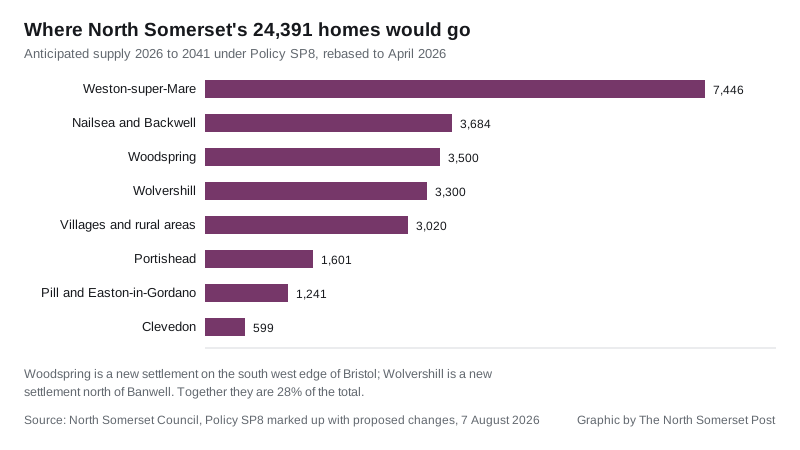
The council has now given the inspectors a fuller version of the table that shows where those homes would go, split into existing commitments, allocated sites and expected small-site windfall. Adding the eight areas together gives an anticipated supply of 24,391 homes, a little above the 23,700 minimum:
| Area | Homes | Share |
|---|---|---|
| Weston-super-Mare | 7,446 | 31% |
| Nailsea and Backwell | 3,684 | 15% |
| Woodspring (south west Bristol) | 3,500 | 14% |
| Wolvershill (north of Banwell) | 3,300 | 14% |
| Villages and rural areas | 3,020 | 12% |
| Portishead | 1,601 | 7% |
| Pill and Easton-in-Gordano | 1,241 | 5% |
| Clevedon | 599 | 2% |
Two of those lines are new settlements rather than growth around an existing town. Wolvershill, north of Banwell, and Woodspring, on the south west edge of Bristol, together account for 6,800 homes, 28% of the total, on land that currently has none. Clevedon, by contrast, is asked to take 599, and 330 of those are not allocations at all but an assumption that small infill sites will keep coming forward.
The gap between the target and the building
The council published its annual housing land figures on 7 August, and they show how far short of 1,580 a year the district is currently running. Between 1 April 2025 and 31 March 2026, 817 homes were completed in North Somerset. After 23 units lost to conversion, change of use or demolition, the net gain was 794. (Residential Land Survey and Housing Land Supply Position Report April 2026)
That is down from 929 the year before, and below the 890 a year the district has averaged across the 45 years for which the council holds net completion records. The highest year on that record was 2007/08 at 1,474 homes; the lowest was 1991/92 at 406. To hit the plan’s rate, North Somerset would need to build at roughly double last year’s pace, and to beat its own best year on record every year for 15 years.
Small sites did some of the lifting. The council counted 112 net windfall completions on sites of nine homes or fewer in 2025/26: 51 in Weston, 46 across the rest of the district, 8 in Portishead, 7 in Clevedon and none at all in Nailsea. Over the 2006 to 2026 plan period there have been 3,338 such completions, an average of 167 a year. The new plan assumes 200 a year, 3,000 over its lifetime.
The five-year supply, and the catch
Councils must be able to point to five years of deliverable housing land. North Somerset’s requirement, calculated from the government’s standard method and with the required 5% buffer added, is 8,295 homes for the period April 2026 to March 2031.
The council says it can demonstrate 8,371, which it puts at 5.05 years. The margin is 76 homes.
Where that supply comes from matters more than the headline:
- Large sites with full consent: 1,312
- Large sites with outline consent: 829
- Strategic sites with consent: 2,290
- Extant allocations: 347
- Emerging allocations: 2,593
- Small site windfall allowance: 1,000
- Sites with a resolution to grant consent: 0
The 2,593 “emerging allocations” are sites that only exist as allocations in the plan now being examined. The council states the position plainly in the same report: “as the current position relies upon sites identified as residential allocations in the North Somerset Local Plan 2041 that is currently the subject of examination, it will not be relied upon for the purposes of decision-making.”
Take those 2,593 out and 5,778 homes remain, which on the same annual requirement of 1,659 is about three and a half years’ worth. That subtraction is ours, from the council’s own table; the council has not published an alternative figure. It is the reason the plan’s timetable matters beyond planning circles: until the plan is adopted, the authority is in a weaker position when it refuses housing on sites it has not chosen.
The report also records 34 large sites with full planning permission in the district, 17 of them already under construction, with groundworks started on three more.
What changed at the inspectors’ request
The 7 August documents were the council’s second response to the inspectors’ preliminary questions, sent by planning policy manager Natalie Richards. Questions 2 and 3 had asked for the housing supply position to be made clearer, so the council has added a delivery trajectory diagram to Policy SP8 and expanded the distribution table to break each area’s total into commitments, allocations and windfall. (Council’s further response to preliminary questions, 7 August 2026)
Rebasing the table to April 2026 also moved some of the numbers. Weston-super-Mare’s total falls from 7,730 to 7,446, Nailsea and Backwell’s from 3,728 to 3,684, while Pill and Easton-in-Gordano rises from 1,100 to 1,241 and Clevedon from 588 to 599. The overall figure drops from 24,495 to 24,391.
What it means for you
If you object to a site near you, check whether you have a right to be heard. You can appear before an inspector at a hearing only if you commented on the Regulation 19 version of the plan, the final draft submitted in May, and your comment asked for a change. Written objections made at that stage are considered by the inspectors whether or not you speak. Comments made at earlier consultations, including the 2039 and 2040 drafts, are not considered. (Planning Inspectorate guidance)
The programme officers are the way in, not the council. Helen Wilson and Yvonne Parker run the examination independently of North Somerset Council and are the single point of contact for participants, including on access needs at hearings. They can be reached at info@programmeofficers.co.uk.
Nothing is fixed until the inspectors report. They can require changes, called main modifications, and those go out to public consultation before the plan can be adopted. The council cannot adopt a plan the inspectors have found unsound.
If you are buying or selling near an allocation, the site templates are worth reading. The council has published a pro forma for every site in its supply setting out the evidence for when it expects homes to be delivered, alongside the data tables listing each site individually. Both are linked from the council’s residential land page.
We track weekly applications and decisions on our North Somerset planning news page, and the district’s sale prices and averages on our house prices page.
Have your say